Human–robot collaboration
A person interrupts a task, changes the destination, or reaches for an object. Evaluate whether the robot recognizes the new intent and coordinates the handover.
 HelmLabsSign inRequest an invite Talk to Helm
Helm Physical AI / Physical digital twins
Helm builds behavioral environments that teach and test AI judgment. Physical digital twins bring site context, human behavior, and changing task state into robotics simulation and evaluation.
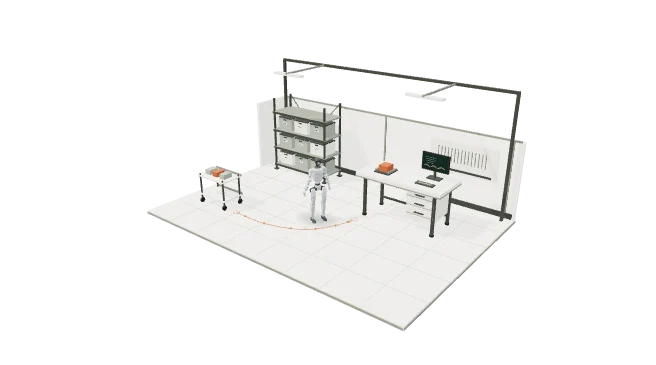
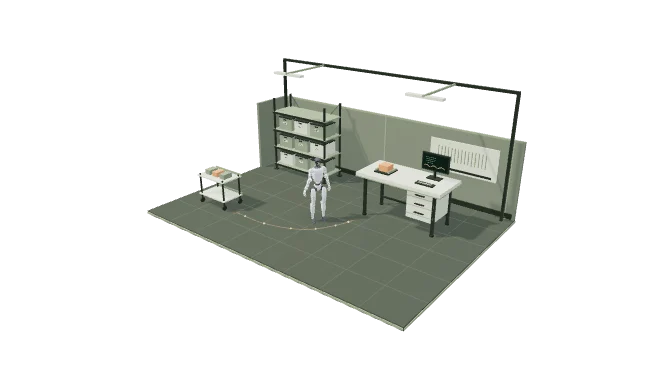
The complete Physical AI portfolio
Connect embodied and decision models, site reconstruction, human behavior, robot inference, evaluation, and coordination across people, robots, and agents.
The decisions between instructions and action
Begin with high-level interaction and recovery. Define the observation, available actions, and expert response before comparing robot policies.
A person interrupts a task, changes the destination, or reaches for an object. Evaluate whether the robot recognizes the new intent and coordinates the handover.
A grasp fails or an object is no longer where it was observed. Evaluate whether the system refreshes its understanding, selects a valid recovery, or asks for help.
Observation age · Recovery choice · Final task state
A route becomes occupied or a station is unavailable. Evaluate whether the policy respects local priorities and finishes the intended task as conditions change.
Explore three illustrative variations. Compare the response and the evidence needed to judge it.
Move a storage unit into the route. Compare clearance, reachability, and whether the policy chooses another path.
Illustrative scenario selector. No physics engine or robot is running.
From human experience to repeatable evaluation
Combine the task environment with human behavior and an explicit standard for what should happen next.
Start from an existing simulation or scoped site evidence. Include demonstrations, operating rules, and reviewed examples of intervention.
Vary intent, timing, object state, and environment conditions. Keep initial states and human responses reproducible.
Compare policies on held-out cases. Check expert agreement and task outcomes, then identify what requires observation on hardware.
Retain failure cases as regression tests. Scope approved corrections for training and measure improvement on independent tasks.
A place in your robotics stack
Helm’s focus is the behavior, task logic, and evaluation surrounding embodied decisions. Scope the connection to your simulator, policy, and robot interfaces around the task.
See the shared Helm foundationBehavioral variations, outcome checks, and reviewed corrections
Compare models and policy versions through an agreed interface
Validate physical assumptions and stopping behavior on the actual system
Environment and interface support are scoped per engagement. Simulation evidence informs hardware testing; it does not establish safe deployment.
Physical AI, explained
A task environment that includes how people act and respond: their intentions, interruptions, corrections, and changing instructions. Evaluation connects the robot’s decisions to an expert standard and an observable outcome.
A scoped environment pack for one embodiment and task family. Agree the task interface, human-behavior variations, baseline comparison, replayable traces, and human and hardware validation plan before the engagement.
Physics and world models address the environment and its dynamics. Helm’s focus is the human behavior, task requirements, and judgment criteria within that environment. The integration and physical assumptions are defined for the chosen task.
Training access and data rights can be scoped separately. Preserve independent evaluation tasks and check transfer against human and hardware observations before interpreting better simulation scores as real-world improvement.
Build with Helm
One embodiment. One environment. A repeatable test of judgment.
Talk to Helm about Physical AI